SUVAT equations: how to choose the right one
Five equations, one condition: acceleration must be constant. Pick the equation by what is missing, fix a direction, then check the answer.
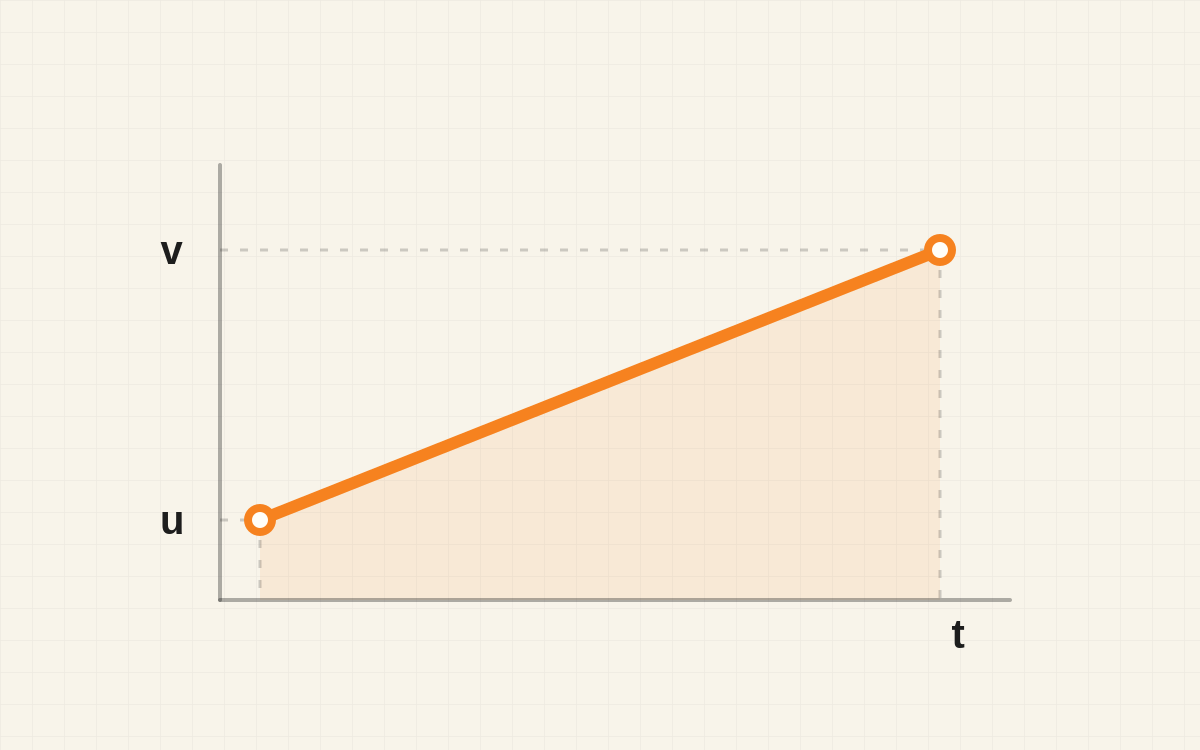
SUVAT questions look like they should be easy. Five equations, five letters, one answer. Most of the marks are lost before the algebra starts: choosing an equation with two unknowns, flipping a sign halfway through, or treating displacement as total distance.
The equations only work when acceleration is constant. That condition is the whole method. If acceleration changes, split the motion into stages or use a graph.
What the letters mean
| Letter | Quantity | Unit | Note |
|---|---|---|---|
| Displacement | m | Straight-line distance from the start, in a stated direction. Can be negative. | |
| Initial velocity | m/s | Velocity at the start of the stage. | |
| Final velocity | m/s | Velocity at the end of the stage. | |
| Acceleration | m/s² | Constant for the whole stage. | |
| Time | s | Duration of the stage. |
Two consequences matter:
- is displacement, not distance travelled. If a particle goes forward and comes back, its displacement can be zero while the distance travelled is not.
- Velocity and acceleration are vectors. Their signs carry direction, so the sign convention has to be fixed before any numbers are written.
The five equations
| Equation | Missing variable | Use it when |
|---|---|---|
| You know or need velocities, acceleration and time. | ||
| There is no final velocity. | ||
| There is no time. | ||
| Acceleration is not mentioned. | ||
| The final velocity is known but the initial is not. |
Most A-level questions need the first four. The fifth is a rearrangement that occasionally saves time.
Choose by what is missing
Use the same four steps every time.
- Draw the motion. Mark the start, the end, and the positive direction with an arrow.
- List , , , and . Write the values you know and a question mark for the unknown.
- Choose the equation with exactly one unknown. If two equations seem possible, one will usually be simpler.
- Substitute, solve, and check. Units, direction, and whether the answer is physically sensible.
Worked example: one stage
A car passes a point at 12 m/s and reaches 20 m/s after 4 seconds at constant acceleration. Find the distance covered.
- , , ,
- Acceleration is not given, so use the equation without .
Check: , and . The two equations agree, which is a good sign.
Fix a sign convention first
Choose positive up or positive down, write it on the diagram, and keep it for the whole question.
A ball is thrown vertically upwards at 15 m/s. Taking and up as positive, find the time until it returns to the thrower's hand.
- (it returns to the starting height)
is the moment of release. The answer is 3.06 s.
If you chose down as positive instead, and . The same two roots appear. The physics does not change, but mixing conventions mid-question does.
Split two-stage motion
When acceleration changes, the motion is no longer one SUVAT stage. Split it at the event where the acceleration changes.
The final velocity of one stage becomes the initial velocity of the next. Displacement can be carried forward, or reset to zero for each stage and added at the end.
Worked example: accelerate then brake
A train starts from rest, accelerates at 1.5 m/s² for 8 seconds, then brakes at 2 m/s² until it stops. Find the total distance travelled.
Stage 1: accelerating
- , ,
Stage 2: braking
- , , ,
- Use :
Total distance: .
The common error is treating the whole journey as one stage with a single acceleration. It is not.
When a graph is easier
A velocity-time graph replaces SUVAT in some questions, especially when acceleration changes.
- The gradient of a - graph is acceleration.
- The area under a - graph is displacement.
- The gradient of an - graph is velocity.
If the graph is already given, use it. If the motion has three stages, a sketch and a few areas can be faster than three sets of equations.
For motion in two directions, split horizontal and vertical. The projectiles topic is the next step after SUVAT.
Common mistakes
| Mistake | Why it happens | Fix |
|---|---|---|
| Using SUVAT when acceleration changes | The question looks like a single stage | Split at the change and label each stage |
| Sign drift | Up is positive for one line, negative for the next | Write the positive direction on the diagram |
| Treating as distance | The particle reverses direction | Track displacement and distance separately |
| Assuming | The object is already moving at the start of the stage | Use the final velocity from the previous stage |
| Choosing an equation with two unknowns | The list was not written out | List all five letters first |
| Rounding too early | Intermediate values are rounded to 2 s.f. | Keep exact values until the final answer |
| Calculator sign errors | Entering instead of | Bracket negative values before squaring |
Exam checklist
- Draw the motion and mark the positive direction.
- Write , , , and with values, signs and units.
- State the equation before substituting.
- Show the substitution, not just the result.
- Give the final answer with units, and a direction if the question asks for a vector.
- Round to 3 significant figures unless the question says otherwise.
- Check the answer against the diagram. A negative displacement may be correct; a negative time usually is not.
Practise with feedback
The SUVAT question set covers single-equation, two-stage and displacement-time problems, with worked solutions.
- Start with single-equation questions until choosing the equation is automatic.
- Move to two-stage problems once signs are secure.
- Use the mechanics hub for projectiles and Newton's laws.
- Use five daily questions to keep the method warm between longer sessions.
The short version
- SUVAT needs constant acceleration.
- Write the five letters before choosing an equation.
- Choose the equation with one unknown.
- Fix the positive direction first.
- Split the motion when acceleration changes.
- Check units, signs and whether the answer makes sense.
The equations are short. The method is what earns the marks.
Practise this now
Put the advice to work with free questions, worked answers and adjustable difficulty.