Command words in maths exams: what each one asks for
The command word tells you what to write. Read it before the numbers, because it decides what your working can earn.
Two students can produce the same correct answer and leave with different marks. The difference is usually the command word, because the mark scheme is built around it.
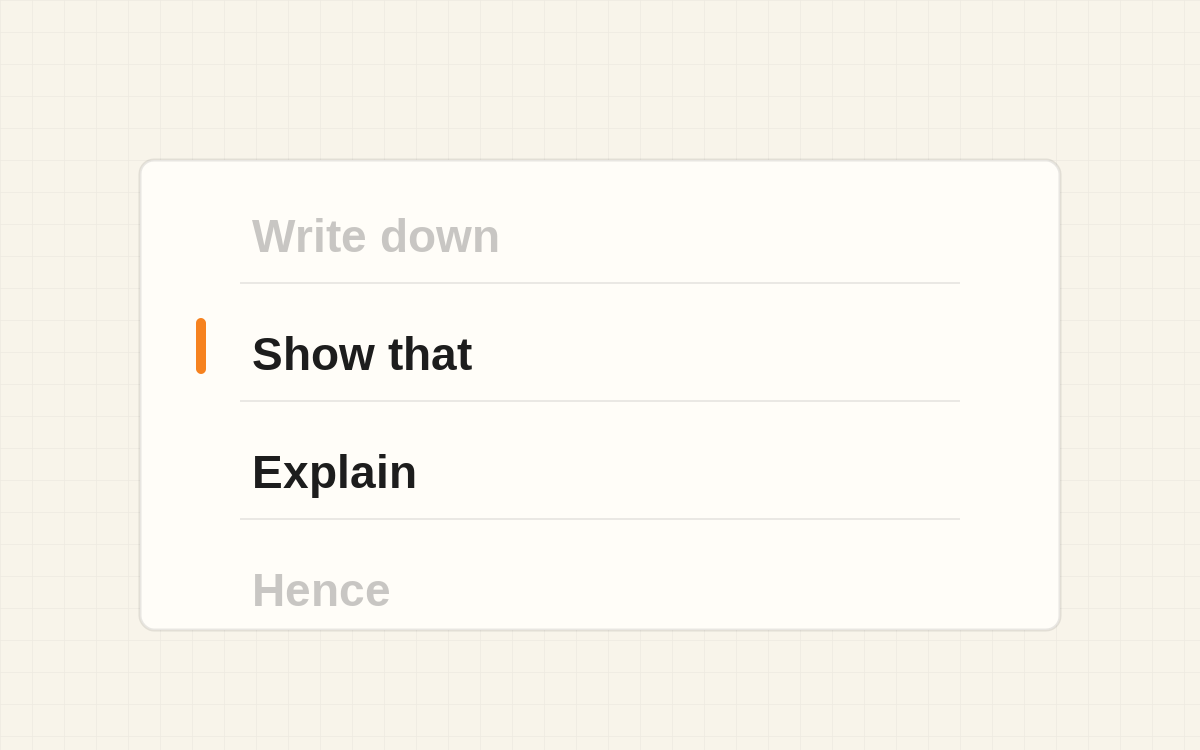
"Write down" wants an answer. "Show that" wants steps. "Explain" wants a sentence. Read the command word before the numbers, and you know what the examiner can award.
The words that set the task
Most GCSE maths questions open with one of these. Learn what each one asks for and the rest of the question gets easier to answer.
| Command word | What to write | Typical tariff | Common trap |
|---|---|---|---|
| Write down, State | Just the answer, with little or no working | 1 mark | Spending two minutes on working that earns nothing |
| Work out, Calculate | Answer plus enough working to show the method | Method and answer marks | Giving only a calculator display |
| Find | The value, usually with a method | Varies | Stopping at a half-finished method |
| Solve | The value(s) that satisfy the equation | Method and answer | Factorising but never solving, or losing a root |
| Estimate | The rounded values you used, then the answer | Method and answer | Working exactly, then rounding at the end |
| Show that | Every step from the starting point to the printed result | All marks for the steps | Writing the printed answer and "therefore" |
| Prove | A general argument, usually with algebra | All marks for the argument | Testing two examples and stopping |
| Explain, Give a reason | A sentence containing a named mathematical fact | 1 mark | Restating the answer in different words |
| Hence | A solution that uses the previous part | Method and answer | Starting the question again from scratch |
| Sketch | Shape and key features, not an accurate plot | 1-2 marks | Plotting dozens of points by hand |
The three boards share this vocabulary. AQA, Edexcel and OCR may use the words at different rates, and OCR adds "evaluate" and "comment", but the meaning does not change between boards.
"Write down" is not "work out"
"Write down" and "state" usually mean the value is visible or already known: read it from a graph, a table, or a previous part.
These questions are often worth one mark and carry no method mark. Writing a full calculation is not wrong, but it costs time you need elsewhere.
The reverse matters more. When a question says "work out" or "calculate", a bare answer can lose method marks. Write the substitution, not just the result.
"Show that" gives you the answer, not the marks
A "show that" question prints the result. That result is never worth a mark. The marks sit in the steps that lead to it.
Take this question.
Show that can be written as .
A full answer completes the square and shows the rearrangement.
Writing ", as required" without the middle lines earns nothing, because the examiner cannot see where the result came from.
Two habits help:
- Start from one side and work towards the printed form. Do not assume the result and manipulate both sides at once.
- Keep every line equivalent. If you multiply by something, say so, and check it is not zero.
"Prove" needs a general argument
"Prove" is not "show that" with a different word. There is no printed answer to aim at, and examples are not a proof.
To prove that the sum of two consecutive odd numbers is a multiple of 4, name the numbers with algebra.
- Consecutive odd numbers: and for an integer .
- Sum: .
- Factorise: .
Since is an integer, the sum is a multiple of 4.
Testing 3 and 5, then 7 and 9, shows the pattern holds in two cases. It does not prove it for every case. The algebra does, which is what the mark scheme wants.
"Hence" sends you back one part
"Hence" means the previous part is part of the method.
Using the completing-the-square result above, "hence solve " starts from .
Starting again with the quadratic formula is not wrong mathematics, but it ignores the instruction. Two related phrases do something different:
- "Hence or otherwise" means you may use the previous part or another method.
- "Otherwise" alone usually means the previous part will not help, so choose another route.
"Estimate" and "exact" pull in opposite directions
An estimate question wants rounded numbers and a sensible answer, not the exact value.
Show the rounded values. A precise calculation followed by rounding at the end misses the point and often loses the method mark.
"Exact" means leave the answer in a form that has not been rounded:
- , not 7.07
- stays as unless the question asks for a decimal
- fractions stay as fractions, not decimals
Read the line after the question as well. "Give your answer to 2 significant figures" overrides an exact answer. "Give your answer in terms of " rules out a decimal.
"Explain" wants a reason, not a restatement
One mark is usually available for a sentence that names the mathematical fact.
Weak: "The mean is higher because it is bigger."
Strong: "The mean is higher because the single large value pulls it upwards, while the median depends on position."
The second answer names the mechanism. For angle questions, name the rule: "angles on a straight line sum to ". For probability, name the condition: "the events are independent, so multiply".
"Justify" and "give a reason" work the same way. "Comment" and "compare" usually need a value from the question plus a statement about it, for example "the median increased by 4 marks".
Sketch, draw, construct, measure
These four are not interchangeable.
- Sketch shows the shape and key features, such as intercepts and turning points, without a scale.
- Draw usually means an accurate diagram, with a ruler where needed.
- Construct means compasses and straight edge, with construction arcs left visible.
- Measure means use the diagram or instruments; do not calculate.
Rubber and compass marks are evidence. Erasing construction arcs can remove the marks that were awarded for them.
The instructions after the question
The final line carries marks of its own. Check it before you write the answer.
- Rounding: "to 1 decimal place", "to 3 significant figures", "to the nearest whole number".
- Units: cm, m², minutes, £. A correct number with the wrong unit can lose a mark.
- Form: "as a fraction in its simplest form", "in terms of ", "exact form".
- Working: "You must show your working" means a correct answer alone may not be enough.
Common mistakes
| Mistake | Why it happens | Fix |
|---|---|---|
| Answer-only response to "work out" | The answer feels sufficient | Write one line of method before the result |
| Full calculation for "write down" | The word looks like a normal question | Check whether the value is already given or visible |
| "Show that" without steps | The printed answer looks like the finish line | Work towards it line by line |
| Proving with examples | Examples feel convincing | Use algebra with a general letter |
| Ignoring "hence" | The previous part looks unrelated | Start from the result you just found |
| Exact answer given as a decimal | The calculator display feels final | Check for "exact" or "in terms of" |
| Estimate worked out exactly | The question looks like arithmetic practice | Round first, then calculate |
| Explanation that repeats the answer | It reads like a complete sentence | Name the rule or mechanism |
Exam checklist
- Underline the command word before starting.
- Check the mark tariff: one mark rarely needs a paragraph.
- For "show that", work towards the printed result and show every line.
- For "prove", define the general case with a letter.
- For "hence", start from the previous answer.
- For "explain", name the mathematical fact.
- Read the final instruction for rounding, units and form.
- If you cannot finish, leave the method visible. Method marks survive a wrong final number.
Practise with feedback
Command words are only useful if you notice them under time pressure.
- Use the past papers library and circle every command word before answering.
- Work through secondary maths questions one topic at a time until the wording stops slowing you down.
- Build a short practice paper from the topics where you lose method marks.
- Use five daily questions to keep the reading habit sharp between full papers.
The short version
The command word is the instruction. "Write down" wants an answer, "work out" wants a method, "show that" wants steps, "prove" wants algebra, "hence" wants the previous part, and "explain" wants a reason. Read it first and the marks stop being a surprise.
Practise this now
Put the advice to work with free questions, worked answers and adjustable difficulty.