How long should you spend on each GCSE maths question?
Timing is a skill you can rehearse. Use the minute-per-mark rule, a simple three-pass plan, and a hard point to move on.
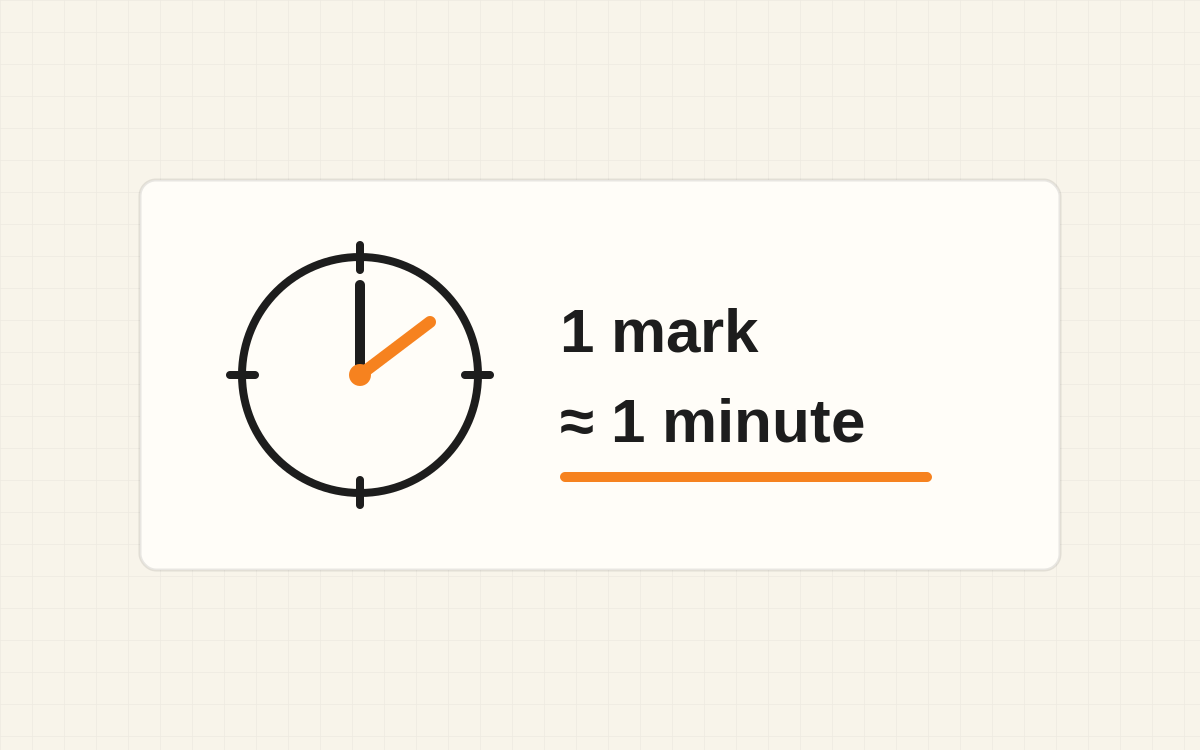
Every GCSE maths paper is 1 hour 30 minutes. The marks change, the questions change, but the clock does not. That makes timing a fixed problem you can prepare for.
The short version: budget about one minute per mark, then protect the last few minutes for checking.
The minute-per-mark rule
Each board writes its papers so that a mark is roughly a minute of work.
| Board | Paper length | Marks per paper | Minutes per mark |
|---|---|---|---|
| AQA | 1 h 30 min | 80 | About 1.1 |
| Edexcel | 1 h 30 min | 80 | About 1.1 |
| OCR | 1 h 30 min | 100 | About 0.9 |
That is why OCR papers feel tighter: the same 90 minutes carries 20 more marks. It is also why a five-mark question on any board should take around five minutes, not fifteen.
What that looks like per question
Use the mark tariff as your first estimate, then adjust for reading and checking.
| Marks | Rough time | Notes |
|---|---|---|
| 1 | 45-60 seconds | Recall or a single step; do not over-explain |
| 2 | 2 minutes | Two steps or a short reason |
| 3 | 3-4 minutes | Method plus substitution |
| 4-5 | 5-6 minutes | Multi-step; write each stage |
| 6 or more | 7 minutes plus | Usually structured; take the parts in order |
A question that takes much longer than its tariff is not automatically worth staying with. Often the method has gone wrong early, and a fresh start later is faster than staring.
A plan for the 90 minutes
First 2-3 minutes: scan
Count the pages, note the total marks, and find the two questions you would skip if time ran out. Do not start solving yet. This stops the surprise of a long final question.
First pass: answer what you can
Work through the paper in order. Answer the questions you can start immediately, and give each one about its mark tariff.
If you have no route after 60-90 seconds, mark the question with a star and move on. A blank star is easier to return to than a question you have been stuck on for eight minutes.
Second pass: spend the banked time
With around 15 minutes left, go back to the starred questions. You now have time that other students have spent staring. Start with the ones worth the most marks.
Final 5 minutes: check the cheap things
- Did you answer the question asked, not a different one?
- Are the units right?
- Is the rounding as requested?
- Have you copied answers correctly from a diagram or table?
- For an equation, does your answer substitute back?
These checks recover more marks than another attempt at the hardest question.
Why leaving a question is the right move
Marks are worth the same wherever they appear. Ten minutes on a two-mark question is ten minutes not spent on two four-mark questions.
The discomfort is psychological, not mathematical. You feel like you are giving up. In practice you are reallocating time to questions you can actually finish.
Practise timing on purpose
Timing improves with rehearsal, not with advice.
- Do one section at a time with a timer, then compare minutes used with marks available.
- Keep a simple note: question number, marks, minutes, whether you finished.
- After three papers, you will see your personal pattern. Most students are slow on a specific type, not slow everywhere.
- Once sections are comfortable, sit a full paper in one 90-minute block.
Use the past papers library for real papers and the paper builder for short timed sets when you do not want to use a whole paper.
Do not trade accuracy for speed
Speed without method loses marks twice: the answer is wrong, and there is no working to award.
- Write the substitution, not just the result.
- Show one line of reasoning for "show that" questions.
- Keep signs and brackets visible; do not do three steps in your head.
- If you are running out of time, write the method even when you cannot finish the arithmetic.
A method mark is still a mark.
Higher tier and calculator papers
The timing rule holds across tiers. Higher tier questions are often worth more marks, so they take longer, but the pace per mark stays similar.
Calculator papers are not automatically faster. The calculator removes arithmetic, not the need to choose a method, set up an equation or interpret an answer. Some students lose time because they trust the calculator output without checking whether it is sensible.
The one-line version
One mark, one minute. Star anything you cannot start in 90 seconds, bank the rest of the paper, and spend the last five minutes checking units, rounding and the question you were actually asked.
Practise this now
Put the advice to work with free questions, worked answers and adjustable difficulty.